Integration
The layer between your systems.
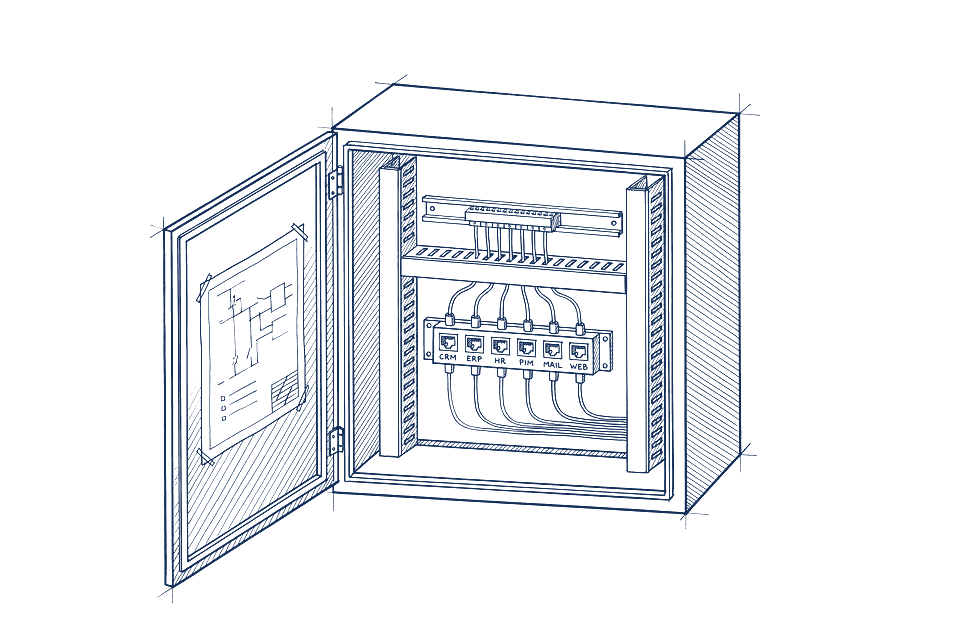
A mid-sized company with 300 employees has a CRM system, an ERP system, an HR system, a product information management system (PIM), a ticketing system, Microsoft 365 and a website. Each works on its own. The work happens in between: copying, reconciling, transferring, chasing. That is exactly where the second shift sits: we build artificial intelligence (AI) into Salesforce, NetSuite, SAP or Personio, via the interface. And where a system does not fit your workflow, we replace it with a tool that does.
Systems
Systems we work in
The list reflects the typical system landscape of mid-sized companies; it is not a list of partnerships. We are not tied to any vendor. Under each family is what we typically build there: with a client case, or explicitly marked as possible.
- CRM and salesSalesforce, Pardot, HubSpot, Pipedrive, Microsoft Dynamics 365 Sales, Zoho
What we typically build thereReading enquiries, classifying them and creating them in the CRM with all details, cleaning up duplicates, enriching company data. Connecting to Salesforce often starts with sorting out junk data. At a spare parts dealer, a workflow filters placeholders, drawing numbers in the name field and discontinued products out of the Salesforce data before pages and texts are generated from it.
- ERP and inventoryNetSuite, SAP S/4HANA and Business One, Microsoft Dynamics 365, weclapp, Odoo, Sage
What we typically build thereClassifying enquiries by market and country of origin and passing them to the responsible team in the sales pipeline. That is how AI runs with NetSuite at a technology distributor across twelve locations in Europe. Possible, with the same check before booking: reading orders and delivery notes from emails and creating them as records in the ERP.
- HR and recruitingPersonio, SAP SuccessFactors, Workday, softgarden, d.vinci, applicant management portals
What we typically build thereBringing vacancies from the HR system onto the website, like the import of job ads from SAP SuccessFactors at a fuel cell manufacturer. Possible, not yet built for a client: a Personio integration that reads applications from the inbox and creates them in structured form, without assessing them. The decision stays with a person, and the works council receives the documents for it.
- Product data and PIMAkeneo, Pimcore, manufacturer databases, ETIM and BMEcat catalogues, Excel and CSV files
What we typically build thereGenerating structured product data and texts from manufacturers' PDF data sheets, checked before they go live, as at a technology distributor. Possible with the same checks: checking ETIM or BMEcat catalogues for gaps and contradictions and proposing missing attributes.
- Communication and serviceMicrosoft 365 and Exchange, Google Workspace, Postmark, Brevo, Freshdesk, Zendesk, phone systems with an interface
What we typically build thereTranslating service content according to a technical glossary, at a fuel cell manufacturer in eleven languages, filling only empty fields and leaving checked texts untouched. In our own operations, calls are captured and created as records with customer, request and next step.
- Web, shop and contentWordPress, TYPO3, Shopware, Magento, custom portals, Cloudflare
What we typically build thereManufacturer texts in a weekly rollout, with eleven checks before every go-live and a kill switch, as at a spare parts dealer. Checking text inventories across many domains against rules and proposing rewordings for a person to approve, as in the EmpCo check of ten domains.
- Data and analyticsMySQL, PostgreSQL, Microsoft SQL Server, Google Search Console, Matomo, Plausible, Power BI
What we typically build thereMonitoring that reports only deviations: counters, sitemaps, daily clean-up. In our own operations, a check runs every night across the interfaces of dozens of client systems. Only deviations are reported.
- AI modelsAnthropic Claude, OpenAI, Google Gemini, Mistral, open models such as Llama run locally, vector databases for knowledge bases
What we typically build thereThe right model for each workflow: large cloud models for difficult language, small or open models for volume and for data that stays on your own servers. At a technology distributor, the knowledge base sits on its own infrastructure, while the chat in five languages runs on a cloud model under contract. If the model changes, the rules and checks stay.
Your system is not on the list? If it has an interface, we can work with it. We have been doing that since 1998: reading systems, understanding them, connecting them. Getting to know your system is part of the build, not a separate item.
Approach
How we build in, not bolt on
Via the interface, not the user interface
We build on the documented interfaces of your systems. No click bot that breaks when a button moves. No no-code tool whose price doubles next year.
Knowing the limits and staying within them
Every system has query limits, and Salesforce's are very strict. We build with caching, throttling and counters so you stay within your licence. At a spare parts dealer we cut the Salesforce queries by 71 percent without any page getting slower.
Every transfer monitored
Whatever goes from A to B is counted, checked and logged. If a transfer fails, we know before you do. At a fuel cell manufacturer, Salesforce, Pardot, SAP SuccessFactors, Freshdesk and Postmark run side by side this way, with a dashboard for each transfer.
Connect where it fits. Replace where it does not.
Not every system in your company earns its licence. Where your workflow matches the standard, we connect. Where you pay per user and still run the actual workflow in Excel, we build a tool that fits you and connect it to the rest. The decision for each workflow is in the analysis, with your licence costs next to our fixed price.
The code belongs to you
Everything we build is documented, versioned and passes into your ownership once paid. Your IT team or another provider could take it over at any time.
Handover
The first step is a 30-minute call.
You tell us about the workflow that costs you the most time. We tell you honestly whether AI pays off there and what the next step would be. Whether a workflow analysis follows is up to you.